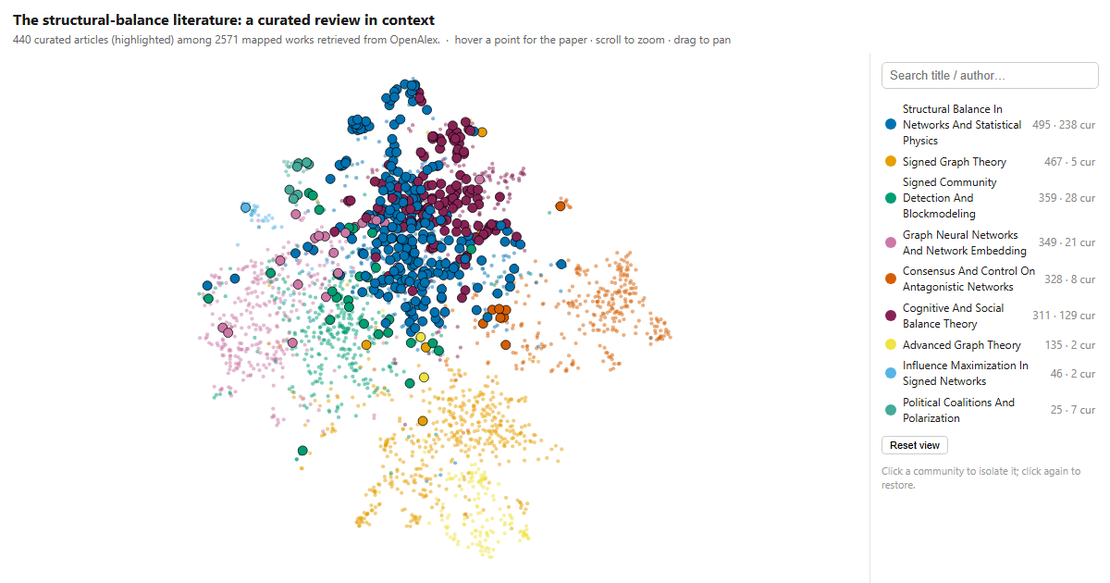
A Curated Review in Context: An Interactive Knowledge Map of the Structural-Balance Literature
When you write a review, one question follows you around: did you cover everything? For an interpretive, physics-oriented review of structural balance the honest answer is “no, on purpose”. The reference list is a curated selection of the work that matters conceptually, not a systematic harvest of every paper that mentions a signed network. The map below is an attempt to show that rather than assert it.
Read More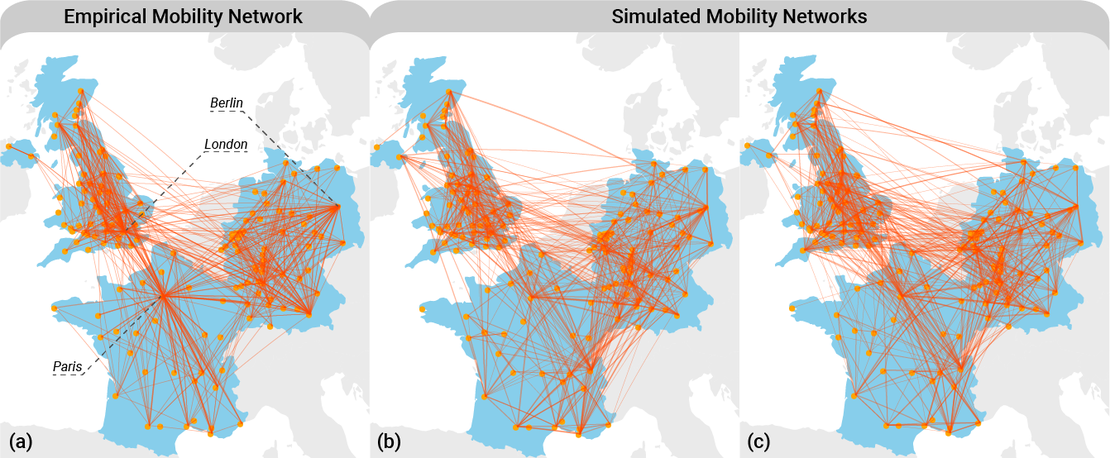
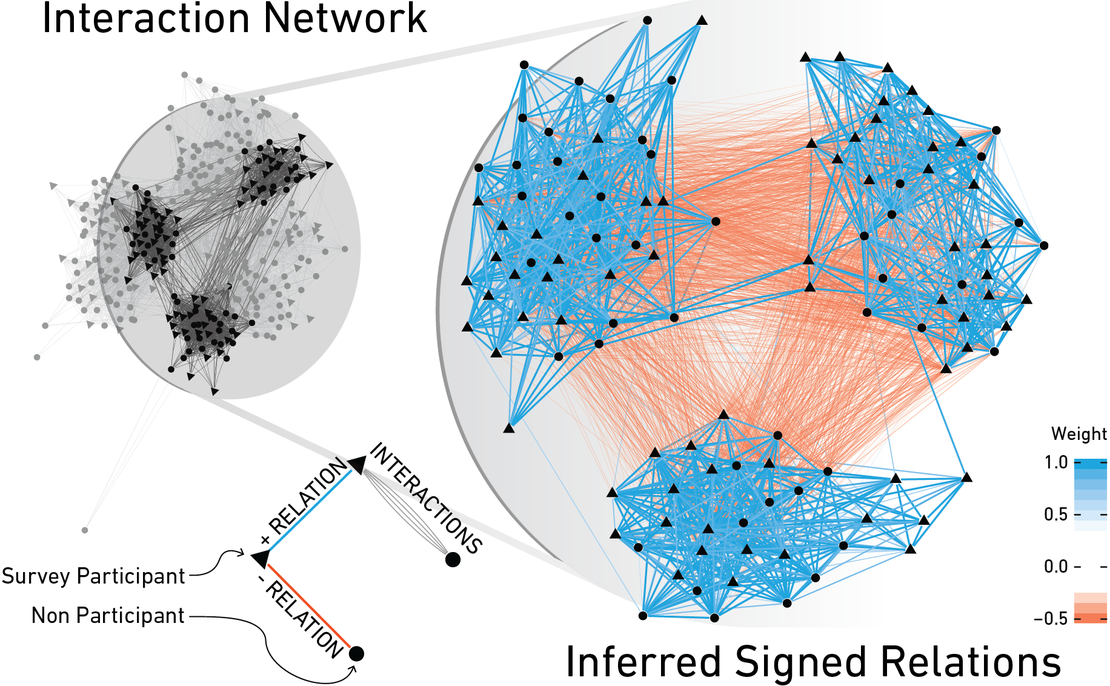
Reconstructing signed relations from interaction data
This study presents a statistical network method to infer weighted signed relations from interaction data. The method, called the Φ-method, assumes that a statistical over-representation of interactions signals a positive relation and an under-representation signals a negative relation. TheΦ-method was tested on four classical interaction datasets and showed promising results in predicting reported relations and reconstructing the underlying relational networks of the communities.
Read More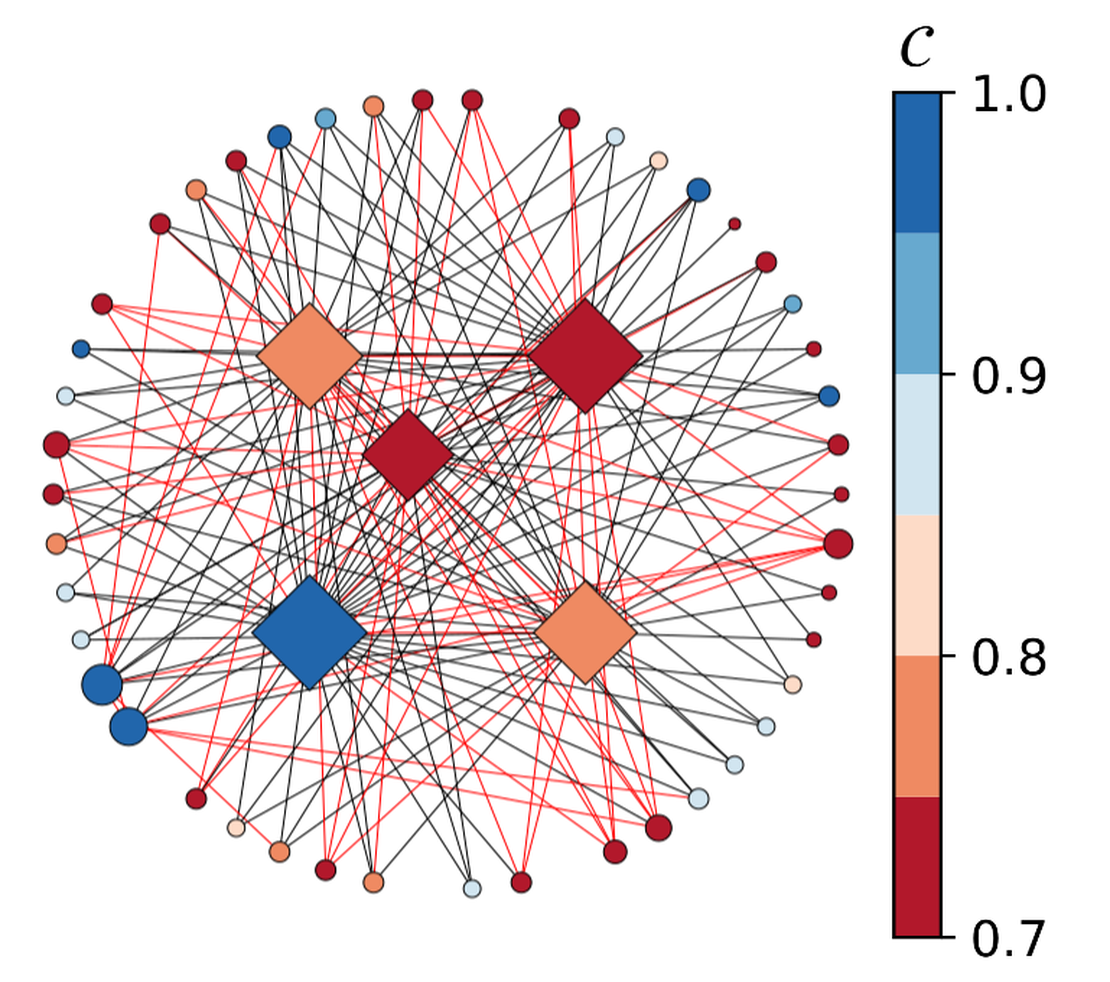
Modeling the impact of environmental consciousness on the supply-demand relationship between firms and customers
The study models the impact of environmental consciousness on the supply-demand relationship between firms and customers. Environmental consciousness can lead to supply-demand deficits, but customers forming unconditional supply links and firms improving their environmental-friendly production can mitigate these deficits. The results show that this approach can inform policies to reduce both supply-demand deficits and environmental pollution.
Read More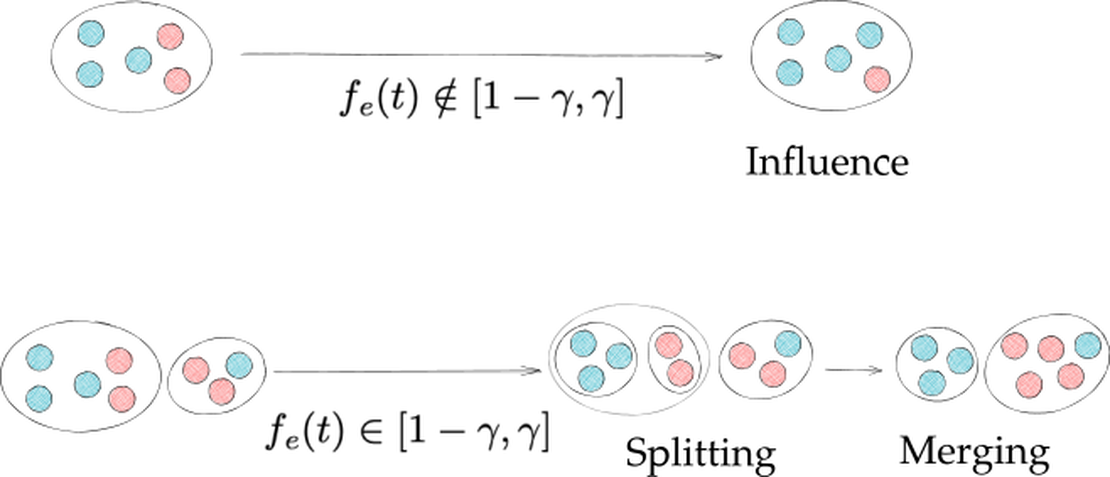
Fragmentation from group interactions: A higher-order adaptive voter model
The adaptive voter model is extended to hypergraphs to study group interactions. The model reveals new phenomena, such as the formation of bands in magnetization and the lack of an equilibrium state. The results indicate that fragmentation decreases with the threshold parameter gamma and initial mean degree. The model provides an analytic explanation for the bands and their discontinuity when the hypergraphs are sparse. The simulations show that the system can split into two components with opposite opinions.
Read More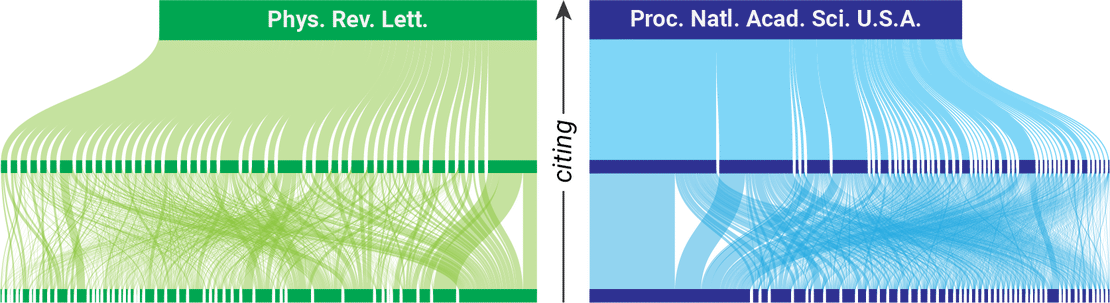
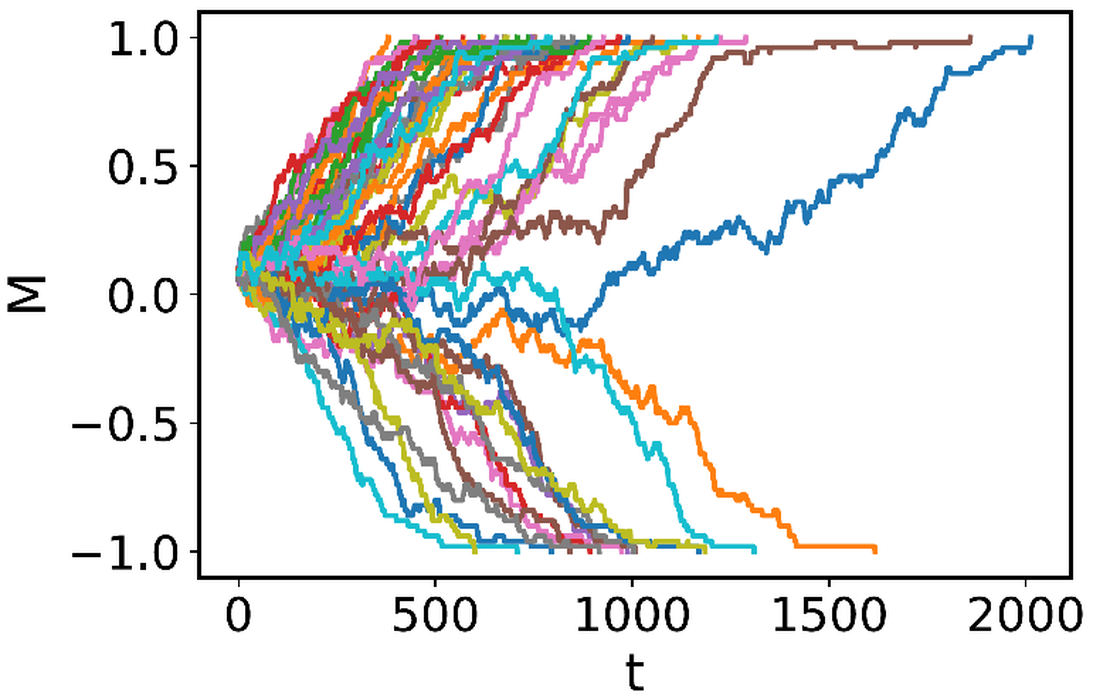
Consensus from group interactions: An adaptive voter model on hypergraphs
The researchers studied how group interactions affect the emergence of consensus in a spin system. They found that group interactions amplify small initial opinion biases, accelerate the formation of consensus, and lead to a drift of the average magnetization. The model considers groups of agents represented by hyperedges of different sizes in a hypergraph. The heterogeneity of group sizes is controlled by a parameter β. The study aims to understand the impact of β on reaching consensus. The researchers used computer simulations and an analytic approach to study the dynamics of the average magnetization.
Read More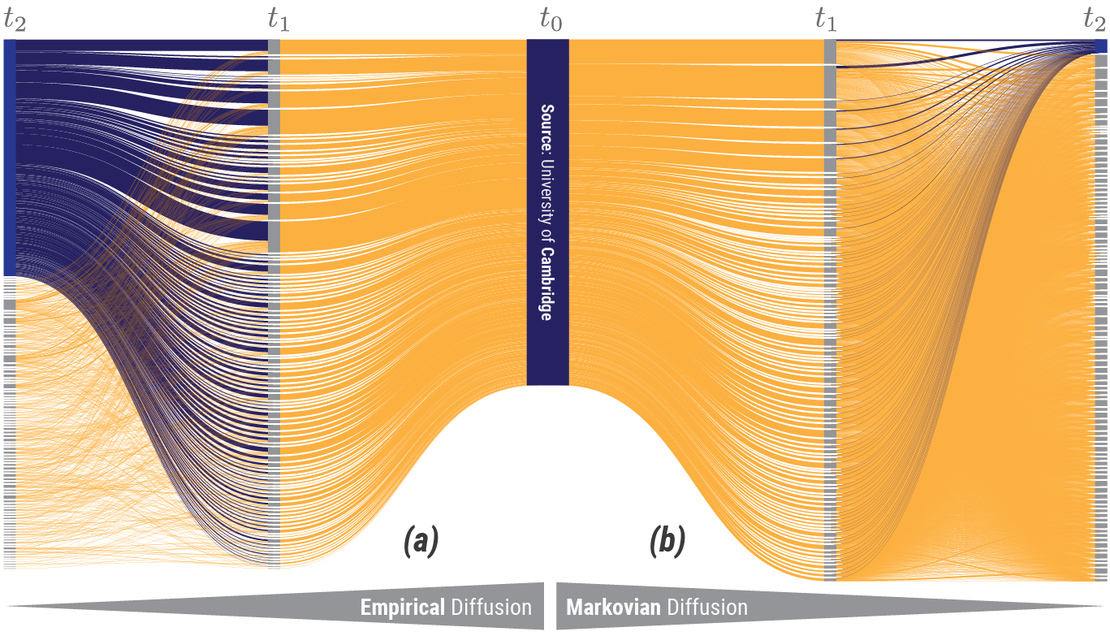
The mobility network of scientists: Analyzing temporal correlations in scientific careers
The study of scientist mobility is important for knowledge exchange and understanding the career trajectories of scientists. The researchers analyzed 3.5 million career trajectories of scientists using a novel method of higher-order networks. They found strong evidence for temporal correlations at the level of universities, indicating that scientists tend to move between specific institutions. These correlations also exist at the level of countries but not cities. The results have implications for the efficiency of mobility programs and the institutional path dependence of scientific careers.
Read More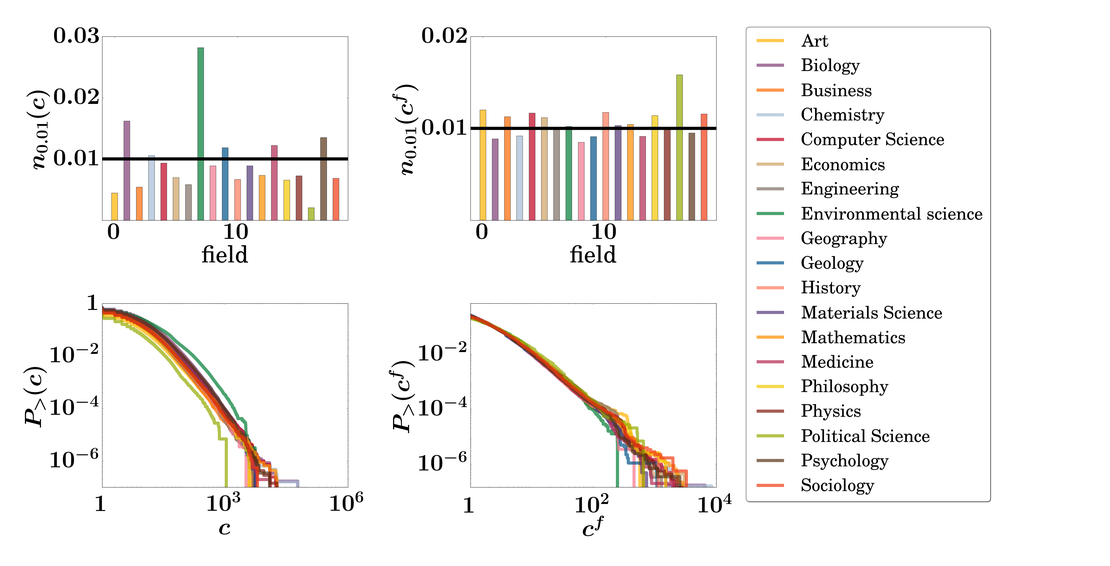
Quantifying and suppressing ranking bias in a large citation network
Citation counts for papers from different fields can't be compared directly because they adopt different citation practices. Researchers have proposed various procedures to suppress these biases, but a new statistical framework shows that existing indicators, including the relative citation count, are still biased by paper field and age. A new normalization procedure motivated by the z-score produces much less biased rankings when applied to citation count and PageRank score. The problem of achieving an ideal unbiased ranking of publications remains open.
Read More