More connections, higher polarization: The role of weak ties and status-driven dynamics
- Piotr J. Górski , Giacomo Vaccario , Janusz A. Hołyst , Michael W. Macy
- June 29, 2026 Official Link
Researchers found that increasing connections in social networks can lead to higher polarization, but through a different mechanism than previously thought.
The increasing prevalence of weak ties relative to strong ties raises important questions about their role in social networks.
Why This Matters for Scientists
As a scientist, you may want to consider the role of weak ties in social networks, as they can amplify status-driven dynamics and increase polarization.
Quick Technical Overview
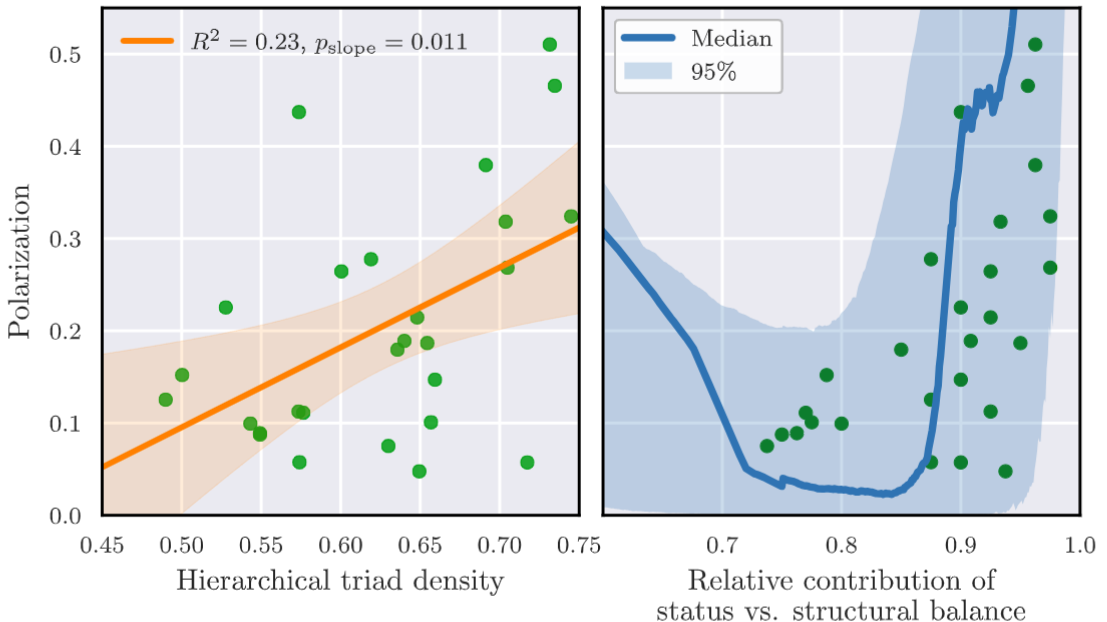
The authors complement previous research by showing that increasing connectivity can promote polarization through the expansion of lower-intensity ties, which amplifies status-driven dynamics.
In line with homophily, strong ties tend to connect similar individuals. Thus, weak ties are more likely to connect dissimilar ones, increasing the role of status.
Summary for Policy Makers
Polarization in social networks can be driven by the increasing prevalence of weak ties, which can amplify status-driven dynamics and lead to a more polarized system. This has implications for how we understand and manage social networks.
Accounting for this interplay between interaction strength and multiple mechanisms, including homophily, structural balance, and status, is therefore essential for understanding the drivers of polarization.
Disclaimer
The above summaries were generated with the assistance of an AI system.
Abstract
Social polarization is central to contemporary scientific and public discourse. Thurner et al. attribute rising polarization to increased social interaction, operationalized as growth in close friendships, within a framework combining homophily and structural balance. However, the evidence for such an increase cannot be completely justified, and an opposing narrative of a "friendship recession" has long been discussed. Here, we complement prior work by showing that increasing connectivity can indeed promote polarization, but through a different mechanism: the expansion of lower-intensity (weak) ties, which amplifies status-driven dynamics.