Machine learning for modeling forest dynamics using National Forest Inventory and climate data
- Dea Rieder , Maximiliano Costa , Christian Temperli , Francesco Giardina , Giacomo Vaccario
- May 5, 2026 Official Link
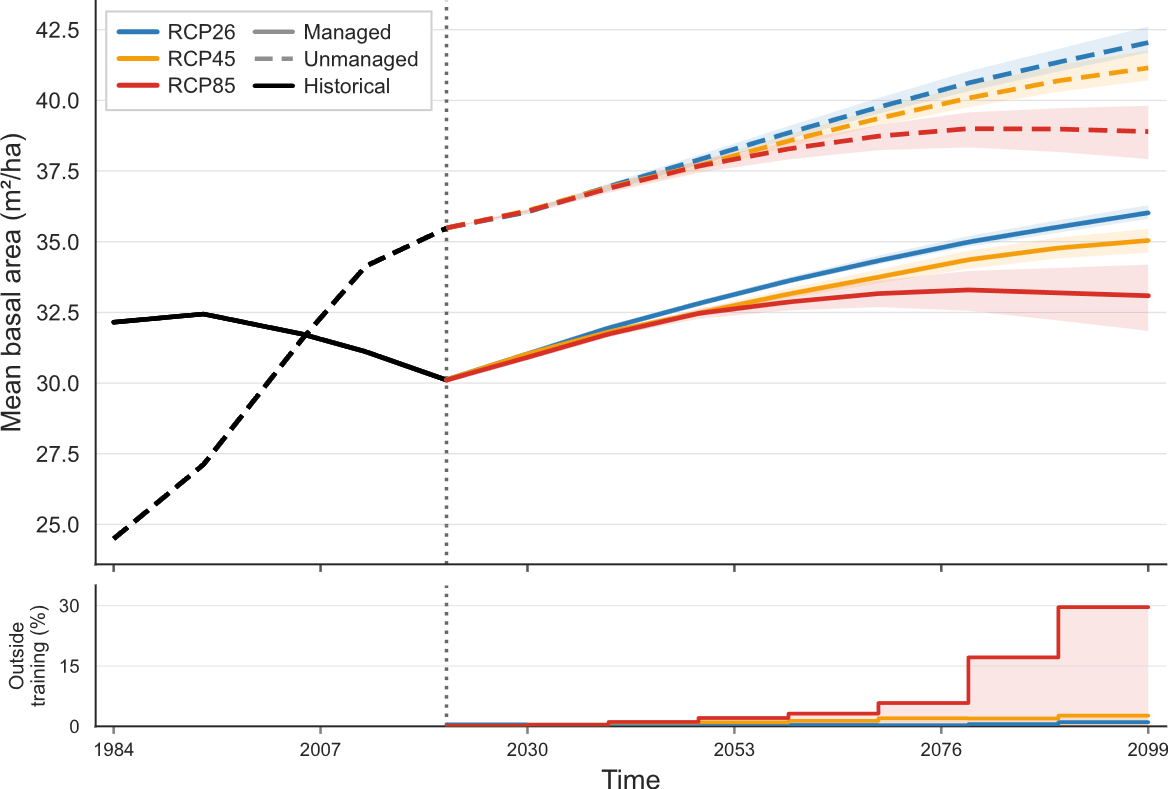
Forest dynamics modeling is crucial for forest management planning. Researchers developed a national-scale XGBoost model using Swiss National Forest Inventory data and climate scenarios to predict changes in basal area and broadleaf proportion. The model's predictions were accurate, with an R2 of 0.66 for basal area and 0.91 for broadleaf proportion. The model's results indicate an overall increase in basal area, although unmanaged lower-elevation belts decrease, and an increase in broadleaf proportion mainly at lower elevations.
The model predicts an overall increase in basal area, although unmanaged lower-elevation belts decrease, and an increase in broadleaf proportion mainly at lower elevations.
Why This Matters for Scientists
You may want to consider using machine learning models for projecting forest dynamics over large areas, as they can capture non-linear ecological patterns and require less detailed initialization data.
Quick Technical Overview
The researchers used Swiss National Forest Inventory data and climate scenarios to develop a national-scale XGBoost model. The model's predictions were accurate, with an R2 of 0.66 for basal area and 0.91 for broadleaf proportion.
The model's predictions were accurate, with an R2 of 0.66 for basal area and 0.91 for broadleaf proportion.
Summary for Policy Makers
This study offers a computationally efficient approach for projecting forest dynamics over large areas. The model's results indicate an increase in basal area and an increase in broadleaf proportion mainly at lower elevations. This approach can assist policymakers in making predictions at national scale based on forest inventory data.
This study offers a computationally efficient approach for projecting forest dynamics over large areas.
Disclaimer
The above summaries were generated with the assistance of an AI system.
Abstract
Accurate prediction of forest structure and composition is essential for forest management, as planning depends on anticipating future stand dynamics under changing environmental conditions. Machine learning algorithms have proven useful for this task due to their ability to capture non-linear ecological patterns in forest dynamics. However, current machine learning applications in forest ecology mostly focus on component growth rates, leaving approaches that directly predict future stand-level states like total basal area and species composition under-explored. This study develops a national-scale XGBoost model for Swiss forests, using Swiss National Forest Inventory data and CH2018 climate scenarios to predict changes in basal area and broadleaf proportion. Tested on a later inventory not used for training, XGBoost predicts the next inventory state with an R² of 0.66 for basal area and 0.91 for broadleaf proportion, slightly above a linear Lasso model (0.65 and 0.90). When applied recursively to generate exploratory projections to 2099, the model indicates an overall increase in basal area, although unmanaged lower-elevation belts decrease, and an increase in broadleaf proportion mainly at lower elevations, especially under high emissions. These trends are similar to patterns reported by established process-based and empirical forest models. This work offers a computationally efficient approach for projecting forest dynamics over large areas, without the extensive parameterization required by process-based models.