Fragmentation from group interactions: A higher-order adaptive voter model
- Nikos Papanikolaou , Renaud Lambiotte , Giacomo Vaccario
- Network theory , Cooperation and opinion dynamics
- March 18, 2023 Official Link
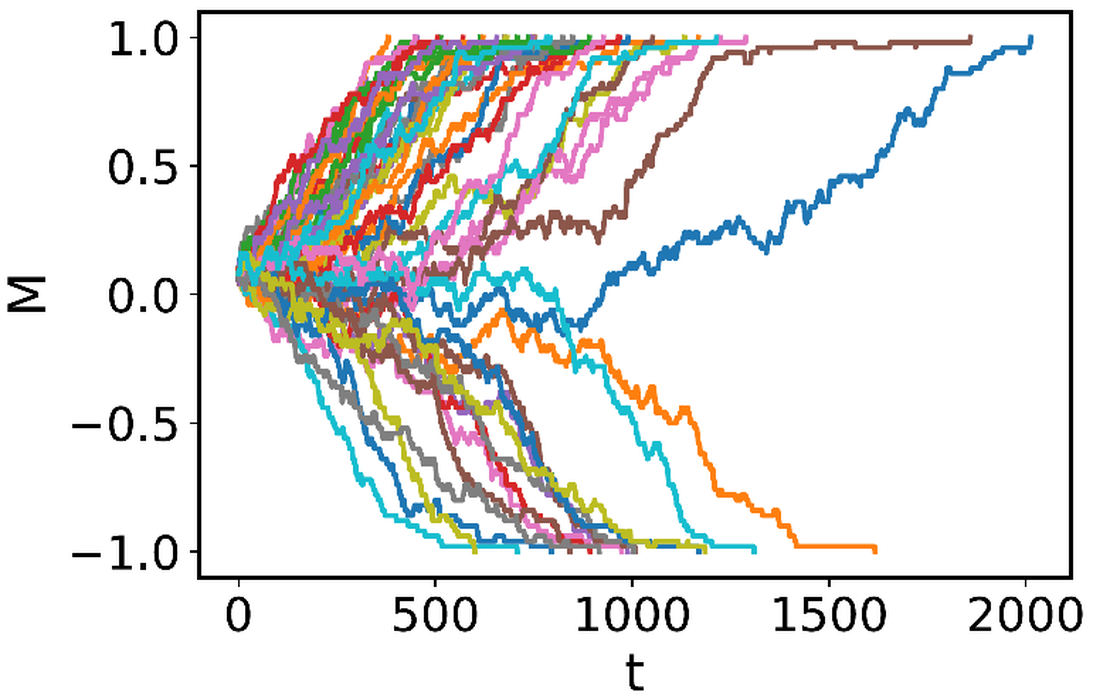
The adaptive voter model is extended to hypergraphs to study group interactions. The model reveals new phenomena, such as the formation of bands in magnetization and the lack of an equilibrium state. The results indicate that fragmentation decreases with the threshold parameter gamma and initial mean degree. The model provides an analytic explanation for the bands and their discontinuity when the hypergraphs are sparse. The simulations show that the system can split into two components with opposite opinions.
The main differences from [22] are two. First, [22] studies the system in a heterogeneous mean-field regime (HMF) where the group size distribution was preserved.
Why This Matters for Scientists
You may want to consider using the hypergraph adaptive voter model to study group interactions in social networks, as it reveals new phenomena and provides an analytic explanation for the bands and their discontinuity. The model is a useful tool for understanding the effects of group interactions on fragmentation and consensus.
Quick Technical Overview
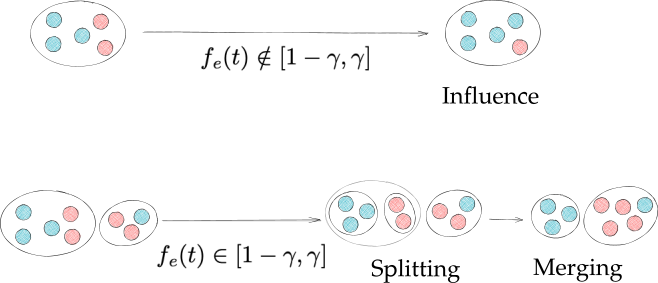
The hypergraph adaptive voter model is an extension of the adaptive voter model, which only considers pairwise interactions. The model uses hyperedges to depict group interactions, allowing for the description of arbitrarily large social groups. The dynamics of the model are based on the adaptive voter model, but with a threshold parameter gamma that determines the critical size of the minority at which either the influence or split-merge process occurs.
We extend this type of models considering group interactions and study how they affect fragmentation.
Summary for Policy Makers
The hypergraph adaptive voter model provides insights into the effects of group interactions on fragmentation and consensus in social networks. The results suggest that fragmentation decreases with the threshold parameter gamma and initial mean degree. The model can be used to inform policy decisions, such as how to design social interventions to promote consensus and reduce fragmentation. The model can also be used to study the effects of group interactions in other fields, such as physics, biology, and ecology.
The model provides an analytic explanation for these bands and their discontinuity when the hypergraphs are sparse.
Disclaimer
The above summaries were generated with the assistance of an AI system.
Abstract
The adaptive voter model allows for studying the interplay between homophily, the tendency of like-minded individuals to attract each other, and social influence, the tendency for connected individuals to influence each other. However, it relies on graphs, and thus, it only considers pairwise interactions. We develop a minimal extension of the adaptive voter model to hypergraphs to study the interactions of groups of arbitrary sizes using a threshold parameter. We study S-uniform hypergraphs as initial configurations. With numerical simulations, we find new phenomena not found in the counterpart pairwise models, such as the formation of bands in the magnetization and the lack of an equilibrium state. Finally, we develop an analytical model using a sparse hypergraph approximation that accurately predicts the bands' boundaries and height.