Reconstructing signed relations from interaction data
- Georges Andres , Giona Casiraghi , Giacomo Vaccario , Frank Schweitzer
- Signed relations , Network theory , Data science
- September 21, 2022 Official Link
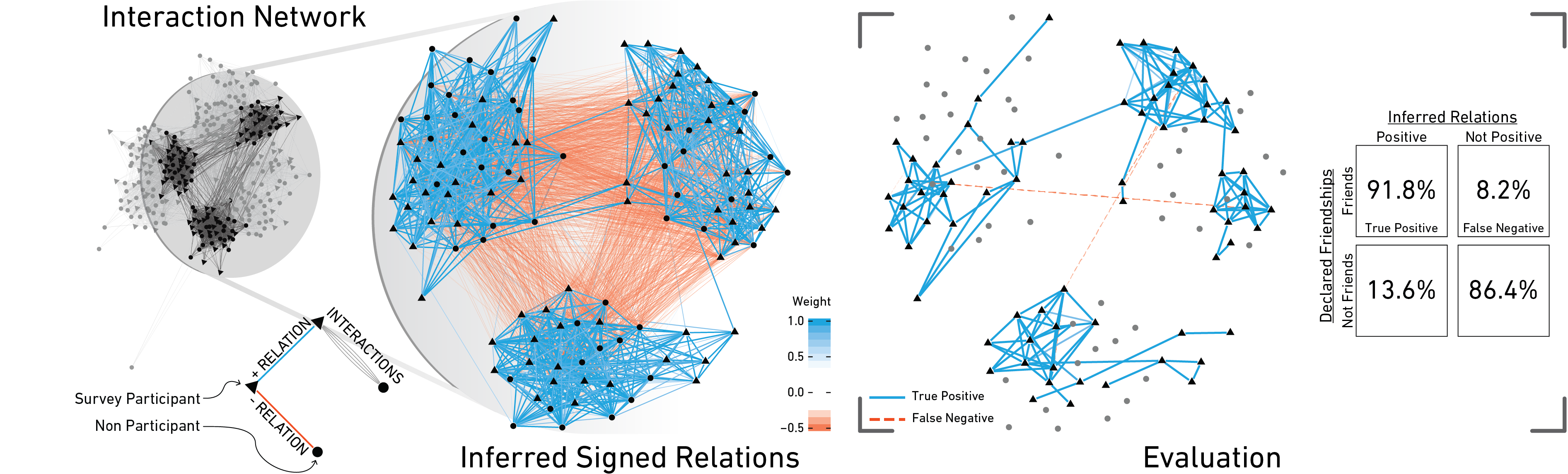
This study presents a statistical network method to infer weighted signed relations from interaction data. The method, called the Φ-method, assumes that a statistical over-representation of interactions signals a positive relation and an under-representation signals a negative relation. TheΦ-method was tested on four classical interaction datasets and showed promising results in predicting reported relations and reconstructing the underlying relational networks of the communities.
The Φ-method relies on the main assumption that a statistical over-representation of interactions signals a positive relation and an under-representation signals a negative relation.
Why This Matters for Scientists
You may want to use the Φ-method to infer weighted signed relations from interaction data, especially when dealing with communities where data about signed relations is rare. The method has been shown to be effective in predicting reported relations and reconstructing relational networks.
Quick Technical Overview
The Φ-method uses a statistical network approach to construct networks of signed relations in four communities. The method relies on the assumption that a statistical over-representation of interactions signals a positive relation and an under-representation signals a negative relation.
This assumption is motivated by the longstanding theoretical argument that individuals with positive relations are more likely to interact.
Summary for Policy Makers
The study's findings have implications for understanding social dynamics and community cohesion. The Φ-method can be used to infer weighted signed relations from interaction data, providing a new tool for researchers and policymakers to study community structure and dynamics.
The inferred signed relations allow us to study pairs and triads of individuals in a new light, and investigate the pairwise homophily, relational triads, and cohesiveness of groups in the communities.
Disclaimer
The above summaries were generated with the assistance of an AI system.
Abstract
Positive and negative relations play an essential role in human behavior and shape the communities we live in. Despite their importance, data about signed relations is rare and commonly gathered through surveys. Interaction data is more abundant, for instance, in the form of proximity or communication data. So far, though, it could not be utilized to detect signed relations. In this paper, we show how the underlying signed relations can be extracted with such data. Employing a statistical network approach, we construct networks of signed relations in four communities. We then show that these relations correspond to the ones reported in surveys. Additionally, the inferred relations allow us to study the homophily of individuals with respect to gender, religious beliefs, and financial backgrounds. We evaluate the importance of triads in the signed network to study group cohesion.