Network embeddedness indicates the innovation potential of firms
- Giacomo Vaccario , Luca Verginer , Antonios Garas , Mario V. Tomasello , Frank Schweitzer
- Science of science , Economic networks
- May 17, 2022 Official Link
The R&D network of 14,000 firms over 25 years was reconstructed to understand how network embeddedness affects innovation potential. This study found that firms with higher weighted k-core centrality have a higher innovation output. This means that being well-connected in the network can lead to more patents.
Firms with a higher weighted k-core centrality in a given year also have a higher innovation output in the following year.
Why This Matters for Scientists
As a scientist, you may want to consider how embeddedness can impact your research. This study found a correlation between a firm's embeddedness and its innovation output. You may want to explore how this concept can be applied to your own research.
Quick Technical Overview
The researchers used data on R&D alliances and patenting activity to study the evolution of the alliance network and the effect of embeddedness on patenting activity. They analyzed a measure, coreness, to quantify the position of firms in the R&D network.
The weighted k-core centrality has the advantage to control for repeated interactions, while the unweighted centrality treats repeated interactions as a single interaction.
Summary for Policy Makers
Policy decisions can be influenced by understanding the impact of network embeddedness on innovation potential. This study suggests that firms with higher embeddedness are more likely to innovate. This has implications for how we design and implement policies to support innovation.
Firms with a higher weighted k-core centrality in a given year also have a higher innovation output in the following year.
Disclaimer
The above summaries were generated with the assistance of an AI system.
Abstract
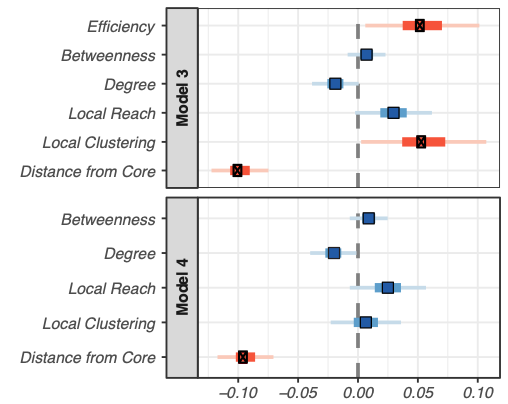
Firms' innovation potential depends on their position in the R&D network. But details on this relation remain unclear because measures to quantify network embeddedness have been controversially discussed. We propose and validate a new measure, coreness, obtained from the weighted k-core decomposition of the R&D network. Using data on R&D alliances, we analyse the change of coreness for 14,000 firms over 25 years and patenting activity. A regression analysis demonstrates that coreness explains firms' R&D output by predicting future patenting.