Modeling social resilience: Questions, answers, open problems
- Frank Schweitzer , Georges Andres , Giona Casiraghi , Christoph Gote , Ramona Roller , Ingo Scholtes , Giacomo Vaccario , Christian Zingg
- Resilience , System thinking
- January 6, 2023 Official Link
A four-step framework is developed to quantify social resilience in highly volatile organizations. The framework combines agent-based and network models to assess robustness and adaptivity. Instantaneous monitoring is possible using longitudinal data, shifting attention from micro configurations to macro-properties of social networks.
Resilience denotes the capacity of a system to withstand shocks and its ability to recover from them.
Why This Matters for Scientists
You may want to consider using this framework to study social organizations, as it provides a novel resilience measure that combines robustness and adaptivity.
Quick Technical Overview
The framework consists of four steps: delimitation, conceptualization, formal representation, and operationalization. It uses a combination of agent-based and network models to quantify resilience.
This framework allows to calculate robustness and adaptivity instantaneously, to estimate the resilience of the organization.
Summary for Policy Makers
Policymakers and stakeholders can benefit from this framework by gaining insights into the resilience of social organizations. The framework can be used to monitor resilience in real-time, enabling data-driven decision-making.
With this the formal modeling of social organizations can be moved to a new level.
Disclaimer
The above summaries were generated with the assistance of an AI system.
Abstract
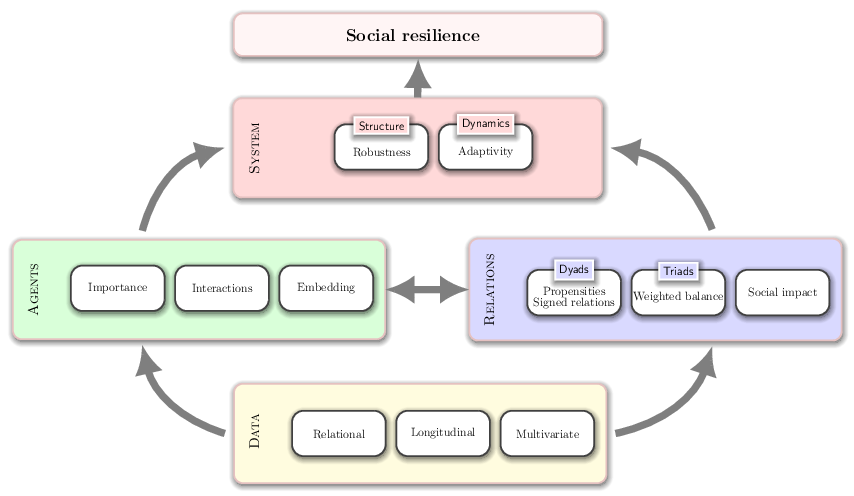
Resilience denotes the capacity of a system to withstand shocks and its ability to recover from them. We develop a framework to quantify the resilience of highly volatile, non-equilibrium social organizations, such as collectives or collaborating teams. It consists of four steps: (i) delimitation, i.e., narrowing down the target systems, (ii) conceptualization, i.e., identifying how to approach social organizations, (iii) formal representation using a combination of agent-based and network models, (iv) operationalization, i.e. specifying measures and demonstrating how they enter the calculation of resilience. Our framework quantifies two dimensions of resilience, the robustness of social organizations and their adaptivity, and combines them in a novel resilience measure. It allows monitoring resilience instantaneously using longitudinal data instead of an ex-post evaluation.