Consensus from group interactions: An adaptive voter model on hypergraphs
- Nikos Papanikolaou , Giacomo Vaccario , Erik Hormann , Renaud Lambiotte , Frank Schweitzer
- Network theory , Cooperation and opinion dynamics
- May 13, 2022 Official Link
The researchers studied how group interactions affect the emergence of consensus in a spin system. They found that group interactions amplify small initial opinion biases, accelerate the formation of consensus, and lead to a drift of the average magnetization. The model considers groups of agents represented by hyperedges of different sizes in a hypergraph. The heterogeneity of group sizes is controlled by a parameter β. The study aims to understand the impact of β on reaching consensus. The researchers used computer simulations and an analytic approach to study the dynamics of the average magnetization.
To adequately represent group interactions, in Sec. II A we utilize the concept of a hypergraph [9].
Why This Matters for Scientists
You may want to consider the implications of group interactions on consensus formation in a spin system. This study shows that group interactions can amplify small initial opinion biases and accelerate the formation of consensus. You may also want to take into account the role of heterogeneity in group sizes, controlled by a parameter β.
Quick Technical Overview
The researchers used a variation of a mean-field approximation called a heterogeneous mean-field (HMF) to analyze the model. The HMF approach considers the distribution of group sizes in the hypergraph, which is controlled by a parameter β.
Our model extends the adaptive voter model by Durrett et al. [28] in that we generalize its rules for hypergraphs.
Summary for Policy Makers
The study of group interactions in a spin system has implications for understanding the emergence of consensus in complex systems. The researchers found that group interactions can accelerate the formation of consensus and lead to a drift of the average magnetization. The model considers groups of agents represented by hyperedges of different sizes in a hypergraph. The heterogeneity of group sizes is controlled by a parameter β. This study can inform policies and applications in areas such as social influence and opinion dynamics.
Group interactions amplify small initial opinion biases, accelerate the formation of consensus, and lead to a drift of the average magnetization.
Disclaimer
The above summaries were generated with the assistance of an AI system.
Abstract
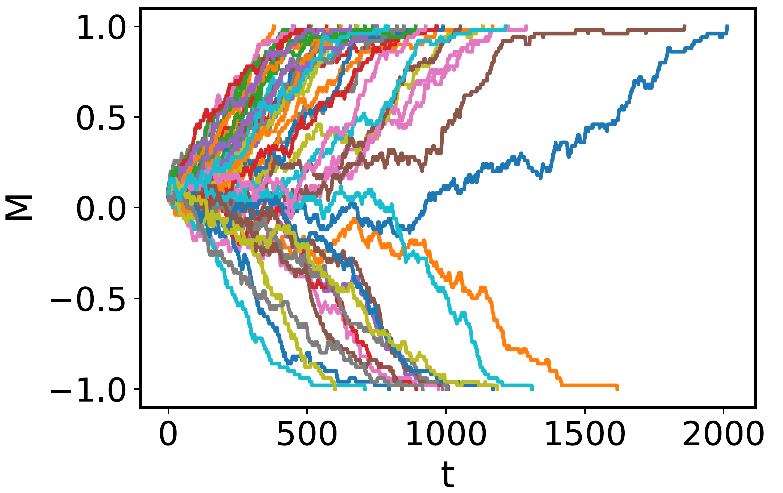
We study the effect of group interactions on the emergence of consensus in a spin system. Agents with discrete opinions (0, 1) form groups. They can change their opinion based on their group’s influence (voter dynamics), but groups can also split and merge (adaptation). In a hypergraph, these groups are represented by hyperedges of different sizes. The heterogeneity of group sizes is controlled by a parameter β. To study the impact of β on reaching consensus, we provide extensive computer simulations and compare them with an analytic approach for the dynamics of the average magnetization. We find that group interactions amplify small initial opinion biases, accelerate the formation of consensus and lead to a drift of the average magnetization. The conservation of the initial magnetization, known for basic voter models, is no longer obtained.