Reproducing scientists' mobility: a data-driven model
- Giacomo Vaccario , Luca Verginer , Frank Schweitzer
- Science of science , Data driven models , Agent based models
- May 24, 2021 Official Link
Scientists often move around the world to share ideas and work together, but how do these moves actually happen? This study looked at millions of career paths to map out how researchers travel between cities, countries and institutions. It found that most scientists prefer to move shorter distances, usually less than 1000 kilometers, and tend to choose places that are both close and well-regarded. The research also showed that the way we visualize these moves changes depending on the scale. At the city level, scientists move more freely, while at the country or institution level, clear pathways called “knowledge corridors” emerge. This helps us understand how knowledge spreads and how scientific careers develop over time, with important implications for both scientists and policymakers.
"Tacit knowledge is constrained in the geographic space."
Why This Matters for Scientists
As a scientist, your next career move could shape your impact and collaborations. This study reveals that proximity and prestige matter: most scientists move to nearby, high-status locations. If you’re planning a move, consider how distance and institutional reputation might influence your opportunities. The research also highlights that career paths aren’t random—they follow patterns, especially at larger scales like countries or institutions. Understanding these trends can help you strategically choose where to work and who to collaborate with, maximizing both your career growth and knowledge exchange.
Quick Technical Overview
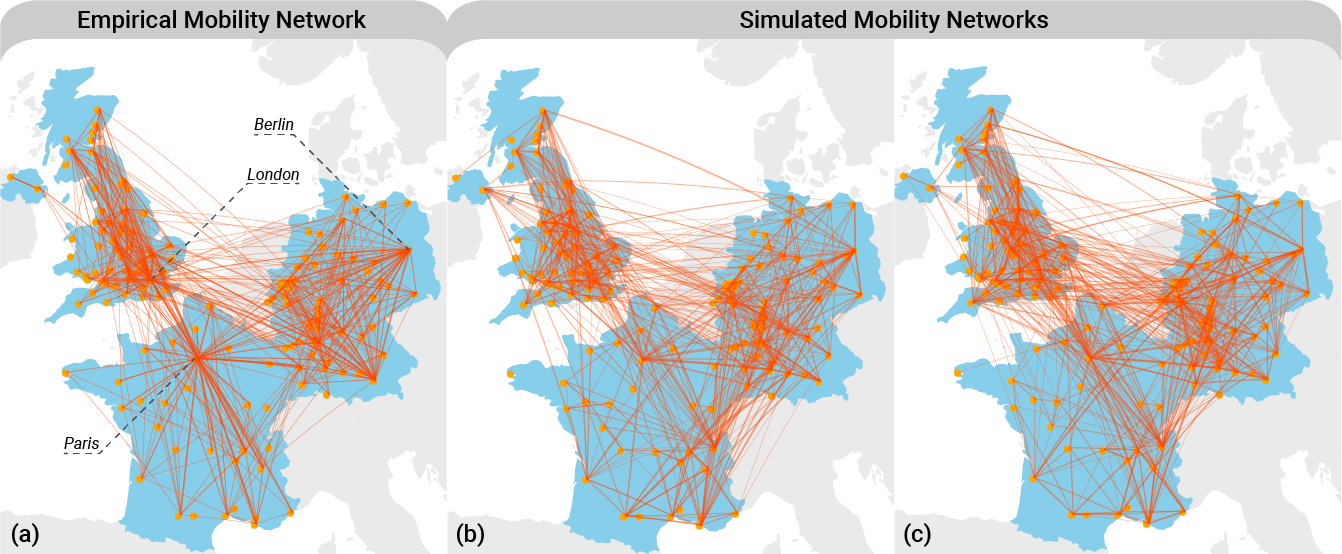
The study analyzed 3.5 million career trajectories from MEDLINE and used an agent-based model to simulate scientists’ mobility. Key findings include the importance of distance and institutional prestige in mobility decisions, with most moves under 1000 km. The research introduces a distinction between “networks” at the city level and “corridors” at country/institution levels, reflecting how aggregation level affects mobility patterns. The model reproduces empirical mobility networks, offering insights into the drivers of scientific migration and knowledge flow.
"Higher-order networks represent these constraints as topological properties."
Summary for Policy Makers
This research provides actionable insights for shaping scientific mobility and innovation policies. Scientists predominantly move short distances, favoring prestigious institutions, which can lead to knowledge clustering in specific regions. Policy makers should focus on creating attractive, well-connected research hubs to foster knowledge exchange and prevent brain drain. At the national and institutional levels, structured “knowledge corridors” emerge, suggesting that targeted investments in collaborations between key institutions can enhance research impact. Supporting mobility programs and reducing barriers for scientists to move between high-potential locations can drive innovation and economic growth.
"Brain circulation at city level."
Disclaimer
The above summaries were generated with the assistance of an AI system.
Abstract
High skill labour is an important factor underpinning the competitive advantage of modern economies. Therefore, attracting and retaining scientists has become a major concern for migration policy. In this work, we study the migration of scientists on a global scale, by combining two large data sets covering the publications of 3.5 million scientists over 60 years. We analyse their geographical distances moved for a new affiliation and their age when moving, this way reconstructing their geographical ``career paths''. These paths are used to derive the world network of scientists' mobility between cities and to analyse its topological properties. We further develop and calibrate an agent-based model, such that it reproduces the empirical findings both at the level of scientists and of the global network. Our model takes into account that the academic hiring process is largely demand-driven and demonstrates that the probability of scientists to relocate decreases both with age and with distance. Our results allow interpreting the model assumptions as micro-based decision rules that can explain the observed mobility patterns of scientists.