The mobility network of scientists: Analyzing temporal correlations in scientific careers
- Giacomo Vaccario , Luca Verginer , Frank Schweitzer
- Science of science , Data science , Network theory
- February 8, 2021 Official Link
The study of scientist mobility is important for knowledge exchange and understanding the career trajectories of scientists. The researchers analyzed 3.5 million career trajectories of scientists using a novel method of higher-order networks. They found strong evidence for temporal correlations at the level of universities, indicating that scientists tend to move between specific institutions. These correlations also exist at the level of countries but not cities. The results have implications for the efficiency of mobility programs and the institutional path dependence of scientific careers.
Our results allow to draw conclusions about the institutional path dependence of scientific careers and the efficiency of mobility programs.
Why This Matters for Scientists
If you are a scientist, this study has implications for your career and research. The findings suggest that temporal correlations play a significant role in shaping scientist mobility, which may influence your career choices and opportunities. You may want to consider the institutional path dependence of scientific careers when planning your research and career goals.
Quick Technical Overview
The study used a novel method of higher-order networks to represent and model sequential data, allowing the researchers to capture temporal correlations. The data was extracted from two large-scale bibliographic datasets, providing a comprehensive view of scientist mobility.
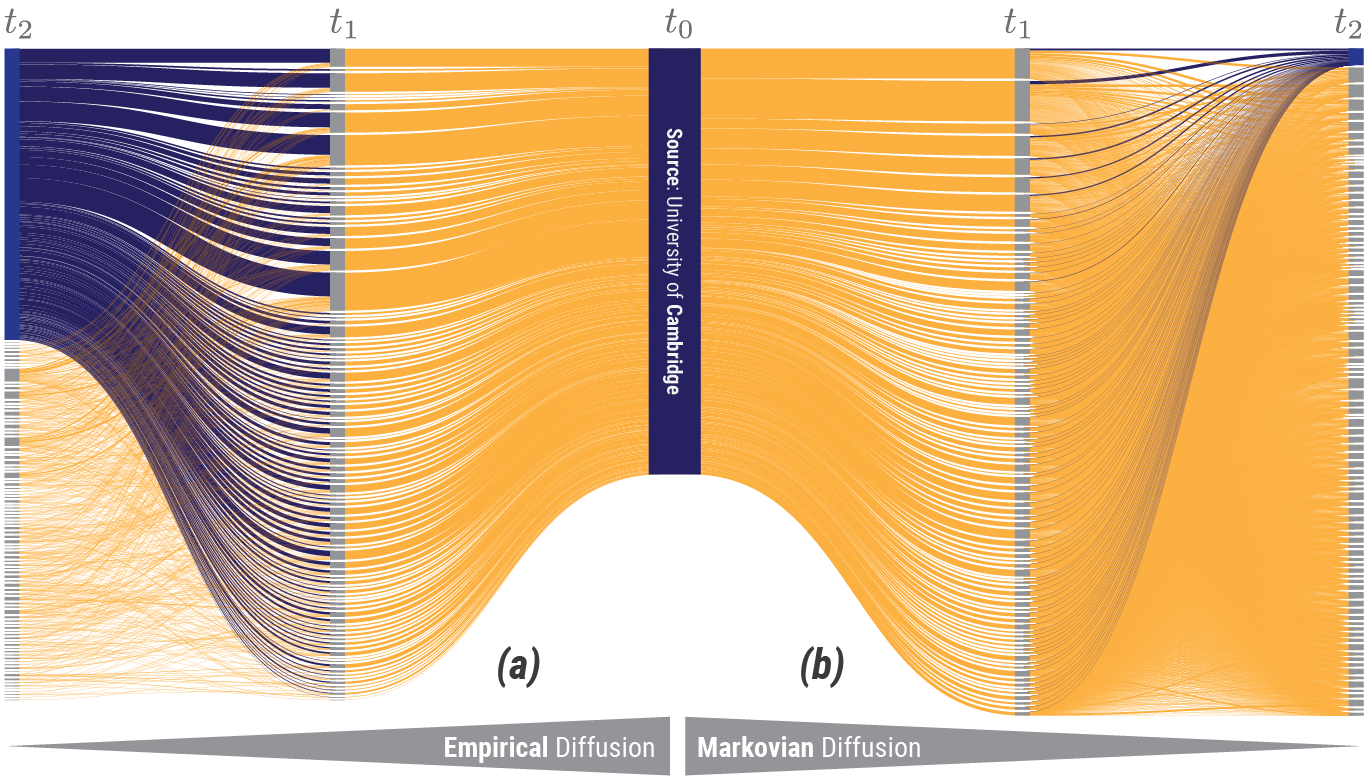
We use Higher-Order Networks, a novel method to represent and model sequential data (Ros-vall et al. 2014;Scholtes et al. 2014;Xue et al. 2016).
Summary for Policy Makers
The study's findings have implications for policy and stakeholders involved in migration and knowledge exchange. The temporal correlations in scientist mobility suggest that mobility programs should be designed to facilitate exchange and mixing between institutions and countries. The results also highlight the importance of understanding the institutional path dependence of scientific careers.
To foster knowledge exchange, it's essential to promote the mixing of different scientific careers and not just follow similar patterns. Our results show that temporal correlations play a significant role in shaping scientist mobility.
Disclaimer
The above summaries were generated with the assistance of an AI system.
Abstract
The mobility of scientists between different universities and countries is important to foster knowledge exchange. At the same time, the potential mobility is restricted by geographic and institutional constraints, which leads to temporal correlations in the career trajectories of scientists. To quantify this effect, we extract 3.5 million career trajectories of scientists from two large scale bibliographic data sets and analyze them applying a novel method of higher-order networks. We study the effect of temporal correlations at three different levels of aggregation, universities, cities and countries. We find strong evidence for such correlations for the top 100 universities, i.e. scientists move likely between specific institutions. These correlations also exist at the level of countries, but cannot be found for cities. Our results allow to draw conclusions about the institutional path dependence of scientific careers and the efficiency of mobility programs.